

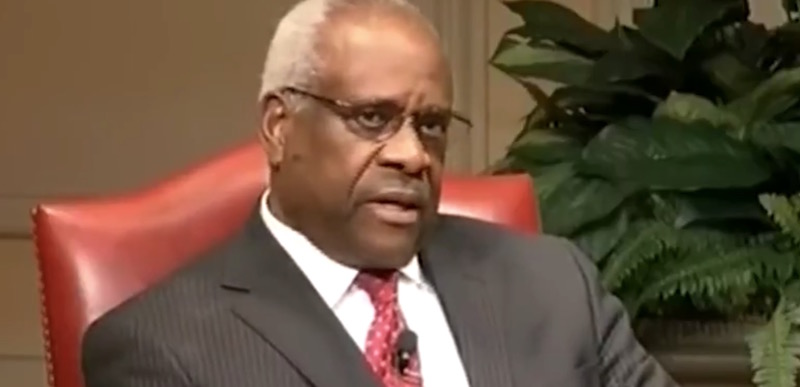

In the ruling this morning where the Supreme Court decided not to consider the part of the Indiana law that dealt with selective abortions, Justice Clarence Thomas wrote a concurring opinion that also laid out how abortion and eugenics go hand in hand and how it all began with Margaret Sanger and Planned Parenthood.
He writes:
This case highlights the fact that abortion is an act rife with the potential for eugenic manipulation. From the beginning, birth control and abortion were promoted as means of effectuating eugenics. Planned Parenthood founder Margaret Sanger was particularly open about the fact that birth control could be used for eugenic purposes. These arguments about the eugenic potential for birth control apply with even greater force to abortion, which can be used to target specific children with unwanted characteristics. Even after World War II, future Planned Parenthood President Alan Guttmacher and other abortion advocates endorsed abortion for eugenic reasons and promoted it as a means of controlling the population and improving its quality. As explained below, a growing body of evidence suggests that eugenic goals are already being realized through abortion.
After this section he goes on to explain we see these eugenics goals evident in our world today.
Here are some highlights from the Christian Post:
“In 1959, for example, Guttmacher explicitly endorsed eugenic reasons for abortion. A. Guttmacher, Babies by Choice or by Chance 186–188 (1959). He explained that ‘the quality of the parents must be taken into account,’ including ‘[f]eeblemindedness,’ and believed that ‘it should be permissible to abort any pregnancy . . . in which there is a strong probability of an abnormal or malformed infant,’” continued Thomas.
Thomas warned that “with today’s prenatal screening tests and other technologies, abortion can easily be used to eliminate children with unwanted characteristics.”
“In Iceland, the abortion rate for children diagnosed with Down syndrome in utero approaches 100%,” he wrote. “Other European countries have similarly high rates, and the rate in the United States is approximately two-thirds.”
“In Asia, widespread sex-selective abortions have led to as many as 160 million ‘missing’ women—more than the entire female population of the United States.”
At the end of his opinion, Thomas says the court cannot avoid this issue forever and is dutybound to address the scope of this constitutional right it created:
The Court’s decision to allow further percolation should not be interpreted as agreement with the decisions below. Enshrining a constitutional right to an abortion based solely on the race, sex, or disability of an unborn child, as Planned Parenthood advocates, would constitutionalize the views of the 20th-century eugenics movement. In other contexts, the Court has been zealous in vindicating the rights of people even potentially subjected to race, sex, and disability discrimination. Cf. Pena-Rodriguez v. Colorado, 580 U. S. ___, ___ (2017) (slip op., at 15) (condemning “discrimination on the basis of race” as “‘odious in all aspects’”); United States v. Virginia, 518 U. S. 515, 532 (1996) (denouncing any “law or official policy [that] denies to women, simply because they are women, . . . equal opportunity to aspire, achieve, participate in and contribute to society based on their individual talents and capacities”); Tennessee v. Lane, 541 U. S. 509, 522 (2004) (condemning “irrational disability discrimination”).
Although the Court declines to wade into these issues today, we cannot avoid them forever. Having created the constitutional right to an abortion, this Court is dutybound to address its scope. In that regard, it is easy to understand why the District Court and the Seventh Circuit looked to Casey to resolve a question it did not address. Where else could they turn? The Constitution itself is silent on abortion.
With these observations, I join the opinion of the Court.
You can read Thomas’ full opinion here, which goes into far more detail. It begins on page 13 and ends on page 32.