

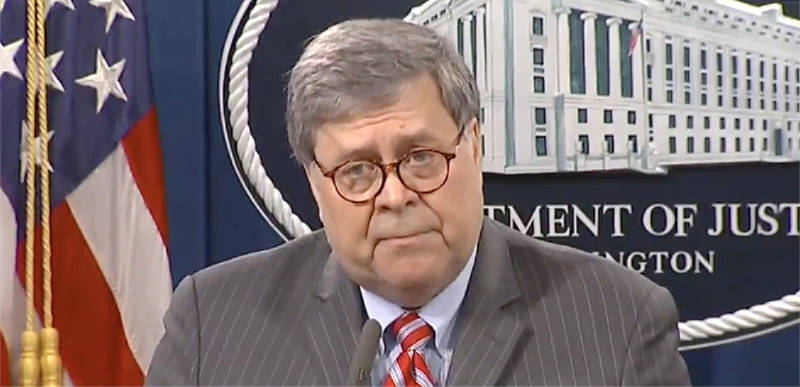

The DOJ today put out it’s report on Section 230, offering up recommendations to crack down on social media companies and keep them from arbitrarily removing comments they don’t agree with:
DC EXAMINER – The Justice Department issued a report proposing that the laws governing internet companies should be reformed and some immunities should be rolled back to help incentivize internet businesses to be “responsible actors.”
Attorney General William Barr said Wednesday that Section 230 of the Communications Decency Act of 1996 must be updated after nearly two decades.
“When it comes to issues of public safety, the government is the one who must act on behalf of society at large. Law enforcement cannot delegate our obligations to protect the safety of the American people purely to the judgment of profit-seeking private firms. We must shape the incentives for companies to create a safer environment, which is what Section 230 was originally intended to do,” Barr said. “Taken together, these reforms will ensure that Section 230 immunity incentivizes online platforms to be responsible actors. These reforms are targeted at platforms to make certain they are appropriately addressing illegal and exploitive content while continuing to preserve a vibrant, open, and competitive internet.”
Barr added, “These twin objectives of giving online platforms the freedom to grow and innovate while encouraging them to moderate content responsibly were the core objectives of Section 230 at the outset.”
“Responsible actors” is something desperately needed.
To this end, the DOJ suggests discarding the language “otherwise objectionable” in Section 230 and to make it more specific, replacing it with “unlawful” and “promotes terrorism”:
The Justice Department’s 28-page report, titled Section 230 — Nurturing Innovation or Fostering Unaccountability?, was the culmination of a 10-month review. It comes shortly after President Trump’s late May executive order, which claimed that Twitter, Facebook, Instagram, and YouTube “wield immense, if not unprecedented, power to shape the interpretation of public events” and that “online platforms are engaging in selective censorship that is harming our national discourse.”
The DOJ report said it aimed to “update the outdated immunity for online platforms” under Section 230 and “identified a set of concrete reform proposals to provide stronger incentives for online platforms to address illicit material on their services while continuing to foster innovation and free speech.”
The Justice Department report said some of its proposed reforms are “intended to clarify the text and original purpose of the statute in order to promote free and open discourse online and encourage greater transparency between platforms and users.” The Justice Department suggested replacing the “vague catch-all” phrase “otherwise objectionable” in Section 230 by replacing it with “unlawful” and “promotes terrorism.” The agency said, “This reform would focus the broad blanket immunity for content moderation decisions on the core objective of Section 230 — to reduce online content harmful to children — while limiting a platform’s ability to remove content arbitrarily or in ways inconsistent with its terms or service simply by deeming it objectionable.”
The Justice Department explained its reasoning in a press release, emphasizing that it was simultaneously looking to encourage the free flow of ideas while discouraging illegal activities.
“Section 230 was originally enacted to protect developing technology by providing that online platforms were not liable for the third-party content on their services or for their removal of such content in certain circumstances. This immunity was meant to nurture emerging internet businesses and to overrule a judicial precedent that rendered online platforms liable for all third-party content on their services if they restricted some harmful content,” the agency said. “However, the combination of 25 years of drastic technological changes and an expansive statutory interpretation left online platforms unaccountable for a variety of harms flowing from content on their platforms and with virtually unfettered discretion to censor third-party content with little transparency or accountability.”
Other reforms proposed by the Justice Department on Wednesday included “denying Section 230 immunity to truly bad actors” such as child abusers, terrorists, and cyberstalkers, and the reforms would “enable victims to seek civil redress.” The Justice Department said that it “supports reforms to make clear that Section 230 immunity does not apply in a specific case where a platform had actual knowledge or notice that the third party content at issue violated federal criminal law.”
The report said that the law should make clear that “the immunity provided by Section 230 does not apply to civil enforcement by the federal government.” The Justice Department also proposed clarifying that federal antitrust claims “are not covered by Section 230 immunity” because “it makes little sense to enable large online platforms (particularly dominant ones) to invoke Section 230 immunity in antitrust cases.”
Obviously this would take Congress to get on board and make this happen, so who knows if it will actually get done. You can read the full report below: