

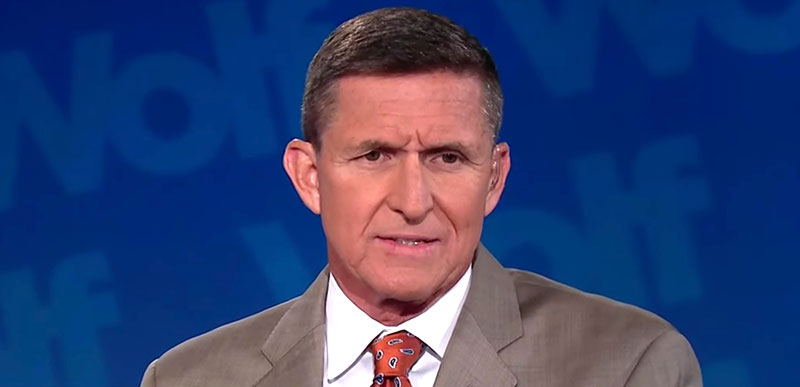

The federal judge who has handled the case against former national security adviser Michael Flynn since 2017 officially dismissed it this afternoon. That’s seven months after the Department of Justice stopped their criminal case against him. Seven months since the DOJ tried to get the court to dismiss the charges.
Seven. Months.
NEW #FLYNN More than 7 months after DOJ motion to dismiss @GenFlynn + a more recent FULL pardon from POTUS, Judge Sullivan dismissed case as “moot” + 43 page opinion @ClareHymes22 @CBSNews pic.twitter.com/eEz4mXja5L
— Catherine Herridge (@CBS_Herridge) December 8, 2020
And even so, the judge went out whimpering about how unfair it is that Trump pardoned Flynn. Really labored over it. For FORTY-THREE pages. And you can forgive MY caps lock since the JUDGE in the case used them to express HIS displeasure TOO. He was spiteful about it, as one observer put it, saying Trump’s pardon made their case MOOT.
Accompanying Judge Sullivan's order is a spiteful opinion supportive of the broader Crossfire Hurricane and Flynn investigations.
He labels the DOJ dismissal as "pretextual" and "dubious"
Full doc:https://t.co/09DHj4brlt pic.twitter.com/g7qDwdosE8
— Techno Fog (@Techno_Fog) December 8, 2020
On and on it went saying how Russia hoax was real and Flynn was liar and on and on. Sullivan wrote that the DOJ’s “motives” in dismissing the complaint were “dubious to say the least.” He parenthetically complained about not being able to judge the “validity” of the presidential pardon, and he took extensive pains to stress how much this doesn’t mean Flynn is innocent of the trumped up charges brought against him as part of a political vengeance plot. Yeah he didn’t say that last part but we know what it was.
Just look at this excerpt.
On the other hand, a pardon does not necessarily render “innocent” a defendant of any alleged violation of the law. Indeed, the Supreme Court has recognized that the acceptance of a pardon implies a “confession” of guilt. See Burdick, 236 U.S.at 94 (“[A pardon] carries an imputation of guilt; acceptance a confession of it.”) ; see also United States v. Schaffer , 240F.3d 35, 38 (D.C. Cir. 2001) (“[A]cceptance of a pardon may imply a confession of guilt.” (citing In re North , 62 F.3d 1434,1437 (D.C. Cir. 1994)). As Chief Justice Marshall wrote, “[a]pardon is an act of grace, proceeding from the power intrusted with the execution of the laws, which exempts the individual on whom it is bestowed, from the punishment the law inflicts for a crime he has committed .” United States v. Wilson , 32 U.S. 150,150 (1833) (emphasis added). In other words, “a pardon does not blot out guilt or expunge a judgment of conviction.” In re North, 62 F.3d at 1437. Furthermore, a pardon cannot “erase a judgment of conviction, or its underlying legal and factual findings.” Arpaio, 2017 WL 4839072, at *1 (citing United States v. Crowell, 374 F.3d 790, 794 (9th Cir. 2004)); but see Schaffer, 240 F.3d at 38 (vacating “all opinions, judgments, and verdicts of this court and the District Court” where “[f]inality was never reached on the legal question of [the defendant’s]guilt” (emphasis added)).
Here, the scope of the pardon is extraordinarily broad – it applies not only to the false statements offense to which Mr. Flynn twice pled guilty in this case, but also purports to apply to “any and all possible offenses” that he might be charged within the future in relation to this case and Special Counsel Mueller’s investigation. Ex. 1 to Consent Mot. Dismiss, ECF No.308-1 at 1. However, the Court need only consider the pardon insofar as it applies to the offense to which Mr. Flynn twice pled guilty in this case. Mr. Flynn has accepted President Trump’s “full and unconditional pardon.” See Consent Mot. Dismiss, ECF No. 308 at 2. The history of the Constitution, its structure, and the Supreme Court’s interpretation of the pardon power make clear that President Trump’s decision to pardon Mr. Flynn is a political decision, not a legal one. Because the law recognizes the President’s political power to pardon, the appropriate course is to dismiss this case as moot. However, the pardon “does not, standing alone, render [Mr. Flynn] innocent of the alleged violation” of 18 U.S.C. § 1001(a)(2). Schaffer, 240F.3d at 38. Accordingly, in view of the Supreme Court’s expansive view of the presidential pardon power, the Court grants the consent motion to dismiss this case as moot.
Gross.
It’s gross throughout, actually, outlining and siding with prosecutors to smear the pardoned Flynn on the way out the door. Someone took this pardon awfully personally.
Copious shots at Trump all the way through, too, by the way, even complaining about the president’s tweets. Petty, spiteful, churlish.
And to think the courts are the only avenue left to purse over vote fraud and theft. What a mess.