

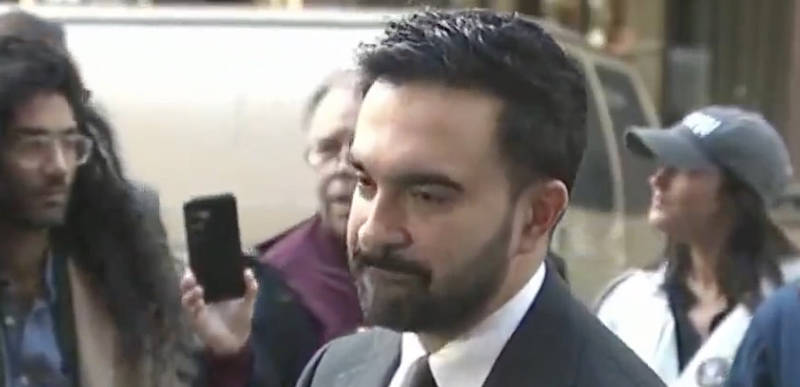

The new commie mayor of New York City didn’t like the attack on Venezuela and the capture of their former dictator and his wife, and took to X to express his disdain:
I was briefed this morning on the U.S. military capture of Venezuelan President Nicolás Maduro and his wife, as well as their planned imprisonment in federal custody here in New York City.
Unilaterally attacking a sovereign nation is an act of war and a violation of federal and international law.
This blatant pursuit of regime change doesn’t just affect those abroad, it directly impacts New Yorkers, including tens of thousands of Venezuelans who call this city home. My focus is their safety and the safety of every New Yorker, and my administration will continue to monitor the situation and issue relevant guidance.
Actually, it wasn’t a violation of federal or international law at all. But more on that in a minute.
Assistant Attorney General Harmeet Dhillon responded to Mamdani’s complaint with the following retweet:
Blah blah cry harder https://t.co/AtPdPIZHt8
— Harmeet K. Dhillon (@HarmeetKDhillon) January 3, 2026
Jonathan Turley weighed in on the legality of all this today, and you can read some of his comments below:
In an extraordinary military operation, the United States launched a large-scale military operation in Caracas, Venezuela, early Saturday, with Special Forces seizing President Nicolás Maduro and his wife. There is a pending 2020 indictment of Maduro in the Southern District of New York, where he is expected to be taken to face prosecution.
The operation comes not long after the 37th anniversary of the capture of Manuel Antonio Noriega on Dec. 20, 1989. Noriega was convicted of drug and money laundering offenses and sentenced to 40 years in prison. He was tried in Miami.
Democratic members quickly denounced the operation as unlawful. They may want to review past cases, particularly the decision related to the Noriega prosecution after his capture by the administration of President George H.W. Bush.
“Without authorization from Congress, and with the vast majority of Americans opposed to military action, Trump just launched an unjustified, illegal strike on Venezuela. He says we don’t have enough money for healthcare for Americans—but somehow we have unlimited funds for war?” wrote Rep. Jim McGovern, D-Mass.
Trump does not need congressional approval for this type of operation. Presidents, including Democratic presidents, have launched lethal attacks regularly against individuals. President Barack Obama killed an American citizen under this “kill list” policy. If Obama can vaporize an American citizen without even a criminal charge, Trump can capture a foreign citizen with a pending criminal indictment without prior congressional approval.
Ordinarily, the Vienna Convention on Consular Relations and other international agreements require the United States to notify the embassy of a foreign national arrested and held in the United States. Notice seems a tad superfluous in this case.
In his appeal, Noriega argued that his arrest violated international law under the head-of-state immunity doctrine. The district court rejected Noriega’s head-of-state immunity claim because the United States government never recognized Noriega as Panama’s legitimate ruler — an argument that will be made in the Maduro prosecution.
The United States for the Eleventh Circuit also rejected the immunity claim.
Noriega also argued that his capture violated the Treaty Providing for the Extradition of Criminals, May 25, 1904, United States of America-Republic of Panama, 34 Stat. 2851 (“U.S.-Panama Extradition Treaty”). The Supreme Court’s decision in United States v. Alvarez-Machain, 504 U.S. 655 (1992), however, was found to bar this argument. The issue was whether he was abducted to the United States with a superseding extradition treaty. The Eleventh Circuit held:
The article of the U.S.-Panama Extradition Treaty upon which Noriega relies for his extradition treaty claim contains almost the same language as the provision of the U.S.-Mexico Extradition Treaty at issue in Alvarez-Machain. See U.S.-Panama Extradition Treaty, art. 5 (“Neither of the contracting parties shall be bound to deliver up its own citizen or subject․”).
Under Alvarez-Machain, to prevail on an extradition treaty claim, a defendant must demonstrate, by reference to the express language of a treaty and/or the established practice thereunder, that the United States affirmatively agreed not to seize foreign nationals from the territory of its treaty partner. Noriega has not carried this burden, and therefore, his claim fails.
The Noriega case offers ample support for the Trump administration, which has had an outstanding arrest warrant for over five years. He is not viewed as the duly elected leader of Venezuela and has been tied to a criminal drug cartel.
The action will also have a major impact on foreign policy. The Monroe Doctrine just became the Trump Doctrine. This action not only confronted Venezuela but also Cuba, which was supplying the security around Maduro. Presumably, Cuban security may have been involved in the firefight. While cutting off vital oil to Cuba, the Trump Administration just delivered a blow against the Cuban regime — arguably one of the most stinging defeats since crushing the Cuban forces in Grenada in 1983.
Legally, Trump has the upper hand in this case. Maduro will replay the arguments from the Noriega case. However, he presents an even weaker case on the merits under the controlling precedent than did Noriega.