

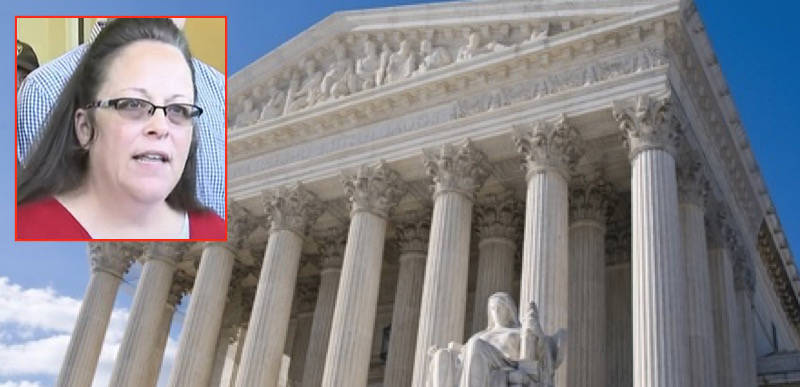

The Supreme Court will consider in November whether to review the challenge against same-sex marriage by former county attorney Kim Davis, who refused a decade ago on religious freedom grounds to issue marriage licenses to same-sex couples after the Supreme Court made gay marriage legal across the country.
Justices will meet on whether to review the case on November 7 and we should hear soon thereafter if they’ve granted certiorari.
Here’s a great write-up from SCOTUSblog on this:
The court is scheduled to consider whether to hear Kim Davis’ challenge to same-sex marriage at their private conference on Friday, Nov. 7. As a general practice, the court does not grant review without considering a case at at least two consecutive conferences; this is the first conference in which Davis’ challenge will be considered. If the justices deny review, however, that announcement could come as soon as Monday, Nov. 10.
As SCOTUSblog reported on Aug. 13 (from which this story is adapted), in 2015, shortly after the Supreme Court recognized a constitutional right to same-sex marriage in Obergefell v. Hodges, Davis, a local county clerk from Kentucky, made national headlines when she refused on religious grounds to issue a marriage license to a gay couple, David Moore and David Ermold. Davis’ job description included issuing licenses – such as marriage licenses – to county residents. After the Supreme Court’s decision in Obergefell, Kentucky’s governor at the time, Steve Beshear, sent a letter to the clerks in all of the state’s counties, directing them to “license and recognize the marriages of same-sex couples.”
Although a county attorney told Davis that she would be required to issue marriage licenses to same-sex couples, Davis opted instead to stop issuing marriage licenses to anyone – gay or straight. While this moratorium was in effect, Davis refused to issue a marriage license to Moore and Ermold. She told the couple that she was acting “under God’s authority” and that they could get a marriage license in a different county.
Moore and Ermold filed a lawsuit against Davis, alleging that she had violated their constitutional right to marry. In a separate case regarding her refusal to issue any marriage licenses, U.S. District Judge David Bunning ordered Davis to issue the licenses to both gay and straight couples. But when Moore and Ermold returned to the Rowan County Clerk’s office, seeking a marriage license in light of Bunning’s order, Davis and her deputies once more refused to issue them one.
Davis’ office began to issue licenses again in 2016, after the Kentucky Legislature passed a law that sought to accommodate clerks opposed to same-sex marriage by removing their names and signatures from the licensing forms. Moore and Ermold’s case continued, and in 2023 a jury awarded them damages of $50,000 apiece.
Davis appealed to the U.S. Court of Appeals for the 6th Circuit, where she argued (among other things) that she could not be held liable because issuing Moore and Ermold a marriage license would have violated her right to freely exercise her religion.
Earlier this year, the 6th Circuit rejected Davis’ appeal. It reasoned that Davis is protected by the First Amendment when she is a private citizen, but she was acting on behalf of the government when she denied Moore and Ermold’s marriage license – an action that was not protected by the First Amendment. The court of appeals acknowledged that in Obergefell the Supreme Court observed that “many people ‘deem same-sex marriage to be wrong’ based on ‘religious or philosophical premises.’” “But those opposed to same-sex marriage,” the court of appeals wrote, “do not have a right to transform their ‘personal opposition’ into ‘enacted law and public policy.’” “The Bill of Rights,” the court stated, “would serve little purpose if it could be freely ignored whenever an official’s conscience so dictates.”
Davis came to the Supreme Court on July 24, asking the justices to review the 6th Circuit’s decision. She contended that she had appeared before the court as an individual—“not as a state actor and not as a government official with some form of sovereign or qualified immunity.” And in that capacity, she argued, she could not be “on the hook for tort liability as a person, yet have no personal defenses” – such as the First Amendment – “available to her.”
Davis also asked the justices to overrule their decision in Obergefell, arguing that a right to same-sex marriage “had no basis in the Constitution” and left her “with a choice between her religious beliefs and her job.” “If ever there was a case of exceptional importance,” she asserted, “the first individual in the Republic’s history who was jailed for following her religious convictions regarding the historic definition of marriage, this should be it.”
Whether the court will grant review boils down to whether there are four votes to take up the question. Moreover, even if there are four justices who might be inclined to do so, they won’t want to grant review unless they are confident that there is a fifth vote to overturn Obergefell.
This will be a huge case if they decide to review it and if they do, it will come right before another midterm election. I’ll tell you this. You can be sure Democrats want the Supreme Court to overturn gay marriage because they desperately need the outrage momentum to try and take back the House and Senate.