

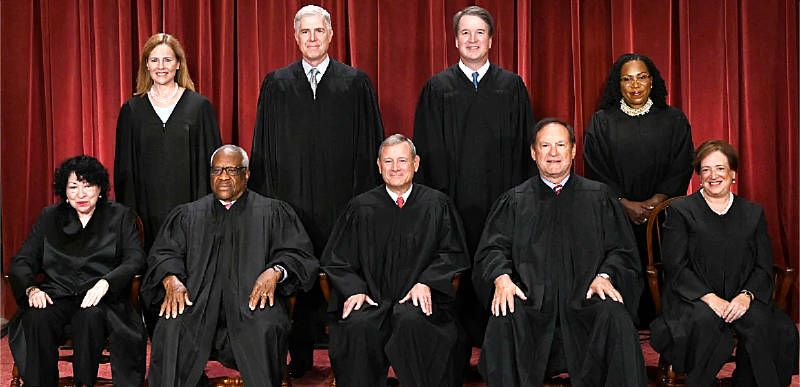

The oral arguments have ended at the Supreme Court this morning on the issue of Universal or National Injunctions, as it relates to the President Trump’s executive order on Birth Right Citizenship.
The arguments weren’t on the merits of the case, but was rather a challenge to the unprecedented National Injunctions by lower courts.
Here’s what Turley wrote earlier today before the arguments began:
Today, the United States Supreme Court will hear three consolidated cases in Trump v. CASA on the growing use of national or universal injunctions. This is a matter submitted on the “shadow docket” and the underlying cases concern the controversy over “birthright citizenship.” However, the merits of those claims are not at issue. Instead, the Trump Administration has made a “modest request” for the Court to limit the scope of lower-court injunctions to their immediate districts and parties, challenging the right of such courts to bind an Administration across the nation.
The case is the consolidation of three matters: Trump v. CASA out of Maryland; Trump v. Washington out of Washington State, and Trump v. New Jersey, out of Massachusetts. These cases also present standing issues since the Administration challenges the argument that there is a cognizable “injury” to individuals who may travel to the states bringing the actions.
However, the main question is the scope of injunctions.
With that context understood, below are his thoughts after the arguments ended – and he is calling it a nail-biter:
…Justices Thomas, Alito, and Kavanaugh seemed strongly in favor of the Administration. Roberts also made repeated points that seemed to support some of the arguments of the Administration, though it was not clear how he would vote…
— Jonathan Turley (@JonathanTurley) May 15, 2025
…On the left, Kagan repeatedly strived to distinguish this case from her earlier objections to universal injunctions under the Biden Administration. She seemed solidly with Sotomayor and Jackson…
— Jonathan Turley (@JonathanTurley) May 15, 2025
…That leaves Gorsuch and Barrett. Gorsuch has previously expressed criticism of universal injunctions but asked probing questions on both sides. Barrett seemed more accommodating in seeking a way to uphold universal injunctions…
— Jonathan Turley (@JonathanTurley) May 15, 2025
Turley finishes by saying:
…In other words, this could be a nail-biter. I think that the Administration still has an advantage in curtailing universal injunctions. However, I did not come away with the sense of a lock with a majority, particularly given Barrett’s questions. I am also unsure how Roberts and Gorsuch will play out on the details. Fortunately, we will likely know within a couple of weeks.