

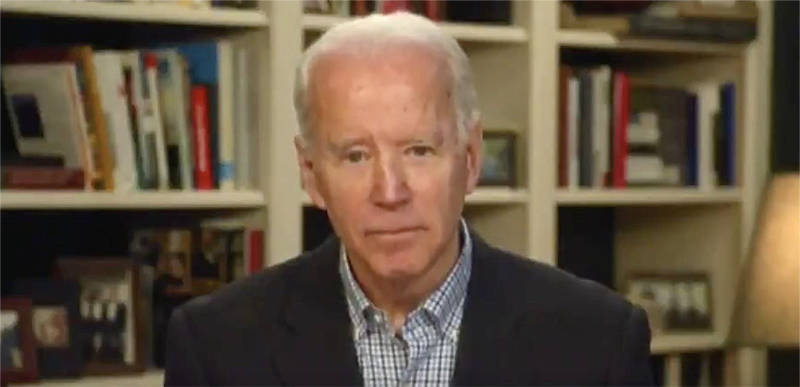

Special Report ran a story tonight on Bernie Sanders endorsement of Joe Biden, and they point out that this comes on the day that serious sexual assault allegations hit the spotlight:
Interestingly enough, this was published on Youtube by Bret Baier himself, the anchor of Special Report. In his tweet he writes “Bernie Sanders endorses his former rival on a day when sexual harassment allegations against Joe Biden gain attention.”
As Peter Doocy points out in the report, Tara Reade filed a police report against Joe Biden near the end of last week detailing what happened. The New York Times finally wrote about the report yesterday, pronouncing their judgement that they “found no pattern of sexual misconduct by Mr. Biden.”
What’s interesting is that today their own media critic wrote a story entitled “The Times Took 19 Days to Report an Accusation Against Biden. Here’s Why.” In the Q&A with Dean Baquet, the executive editor of The Times, Ben Smith asks this very interesting question:
I’ve been looking at The Times’s coverage of Justice Brett M. Kavanaugh. I want to focus particularly on the Julie Swetnick allegations. She was the one who was represented by Michael Avenatti and who suggested that Kavanaugh had been involved in frat house rapes, and then appeared to walk back elements of her allegations. The Times wrote that story the same day she made the allegation, noting that “none of Ms. Swetnick’s claims could be independently corroborated.”
Why was Kavanaugh treated differently?
His point is that it took the New York Times 19 days to report on the accusations against Biden, with Banquet claiming that they wanted to do their own investigating before the story was published to see if they could get it corroborated. That’s what Banquet claimed when asked why it took so long. But when it came to Michael Avenatti and Julie Swetnick’s accusations against Kavanaugh, they hit that the day it came out and didn’t give a flying crap that they couldn’t “independently corroborate” it.
This is the unsatisfactory answer Banquet gave to this question:
Kavanaugh was already in a public forum in a large way. Kavanaugh’s status as a Supreme Court justice was in question because of a very serious allegation. And when I say in a public way, I don’t mean in the public way of Tara Reade’s. If you ask the average person in America, they didn’t know about the Tara Reade case. So I thought in that case, if The New York Times was going to introduce this to readers, we needed to introduce it with some reporting and perspective. Kavanaugh was in a very different situation. It was a live, ongoing story that had become the biggest political story in the country. It was just a different news judgment moment.
That’s a lot of baloney. If anything Kavanaugh’s allegations deserved as much vetting if not more simply because he was being nominated for a position on which he will serve for the rest of his life, on the highest court of the land. If you were going to get something right, you’d want it to be that. But the New York Times didn’t care about getting it right. They simply wanted to add to the burden against Kavanaugh in order to try and kill his nomination. They were adding the weight of their reputation to do what almost all Democrats were doing at the time, trying to crucify Kavanaugh on a bogus charge from his teenage years.
But when it comes to Biden they have to investigate it, research it, and then slide it in when no one is paying attention.
Back to Biden. It was noted in the report above by Doocy, but just to highlight what Biden said two years ago when asked about Anita Hill in light of the allegations against Kavanaugh: “Speaking generally, Biden added, “For a woman to come forward in the glaring lights of focus, nationally, you’ve got to start off with the presumption that at least the essence of what she’s talking about is real, whether or not she forgets facts, whether or not it’s been made worse or better over time. But nobody fails to understand that this is like jumping into a cauldron.””